Overview
I'm happy with my progress, especially at home. Outside the home has been a little more difficult but progress has certainly been made here too. I've turned down free drinks, opted for soft drinks and water instead of a beer. These are things that I never did before.
From 3rd September
In the home.
14 days alcohol free
10 days where I had a glass of red wine (probably 175ml)
1 day where I had two glasses of wine. (note this was Sept 3rd - I decided after, to only drink one glass in the house because it's easier to record and adhere to)
This is a complete change around from how I drank before. Finishing a bottle of wine or more a night was the norm (or not drink at all). After the first couple of times, it certainly feels much more normal now to stop after one glass. It also feels a lot better the day after, I feel much fresher in the morning and more sure of myself.
The use of triggers really helped me moderate. Before, whenever I've tried to moderate, I'd forgot to think about it before I start drinking but with the triggers attached to my bottle of wine it became much easier to set a limit and stick to it.
Outside the house
10th Sept - Street Party with beer that was 'help yourself' - I'm not sure how much I drank as the Dutch use small glasses - probably about 6 pints. I was aware of my drinking and took gaps between drinks.
15th Sept - Went to an open coffee event at an exhibition. Free bar but I choosed to drink sparkling water instead - that was a first!!!
17th Sept - Food buffet with all you can drink - 4 1/2 small glasses of red wine. Had one glass at the start and then switched to soft drinks. I was introduced to the organiser of the event and had another glass. I sat with the organisers of the party and ended up drinking a couple of more glasses. This event was significant for me as I got to see first hand how alcohol affects people. It's not pretty. Most of the organisers had been drinking all night when I joined them. I got to see how alcohol slowed them down and made them look bad - great motivation to be moderate.
30th Sept - Pub night with friends from London -4 1/4 pints. I had wanted to drink three pints but expected to drink 4. The 1/4 come from a mate who had had enough. Started with a lemonade and then 3 pints in a row. Felt quite tipsy after that, so had a pint of water and then another pint. I think it's better to start with a soft drink and then alternate between beer and soft drinks.
I've found drinking out of the home a bit harder to control but this month I've definitely done some new things;
Drank water when there's a free bar.
Stop for a few hours after having a red wine.
Started with a soft drink.
Been controlled, even when drinks are 'free'.
Showing posts with label mid life crisis. Show all posts
Showing posts with label mid life crisis. Show all posts
Monday, 3 October 2011


Monday, 26 September 2011
Trigger Your Motivation
Hangovers Don't Work
Hangovers are like motivation, they never happen at the right time.
How many times have you heard yourself or a good friend say ‘I’m never drinking again, never ever, not after last night!’ But as the hangover goes so does the motivation to stop or drink less. A day later it’s ‘I’m cutting down. I’ll just have a couple every time I drink.’ And a couple of days later when you start drinking again, the hangover’s gone, the motivation’s to drink less has gone and you drink like you always do. Too much!
You know that you drink too much. You know that when you drink too much it can affect you the next day. You know that it does damage your body but yet, you still don’t moderate. Why?
My take on this, is because your brain is busy. Apparently, your conscious brain only holds one thought at a time and the likelihood of it thinking about ‘moderation’ at the right time is slim. There are too many other things to think about.
You could be thinking of your friends, the latest gossip, the bargirl, your wife, that itch that never goes away, stress at work, exercise more etc.
So if motivation doesn’t work well what does?
BJ Fogg has come up with a model of habit change which contains three elements. One of them is motivation and he’s says that motivation is the least important element. The other two are ability (to change) and triggers.
Take smoking for example
• Motivation – most smokers want to give up. They know that their habit is bad for them.
• Ability – most smokers give up when their ability to give up increases. This could be nicotine patches or a new mindset thanks to Alan Carr.
• Triggers – strokes, serious illness, the warning on a cigarette package.
For me, triggers have worked where motivation hasn’t in the past. You need your ‘trigger’ to fire at the right place and the right time. What’s worked has been placing two triggers by my wine bottles.
The first trigger
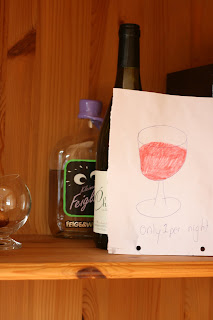 I know, looks like a five year have drawn it. But for me, highly effective
Reminds me that I’m only going to drink one.
It’s been surprisingly effective. Since putting it in place, I’ve only have had one drink a night at home.
It has also helped me build two useful ‘abilities’
1. Helps me to think before I drink. I think that I’m only going to have one. After that I’ll be on water again. I smell my drink more and make more of an effort to saviour it.
2. Stop at one. I only drink one per night because it’s easy to record and I also think it’s easier to stop at one than after two or three.
The second trigger
 Trigger - reminds me to celebrate that I've stopped at one
Reminds me to congratulate myself for only drinking one drink. This is a new habit and if it’s going to replace the old habit I need to enjoy it and celebrate it.
I added this one later as I noticed that I wasn’t always congratulating myself for stopping at one.
I believe this is important as it’s going up against habits that have lasted twenty five years or more.
Conclusion
Triggers have really kept my mind on ‘moderation’. They helped me get off to a great start and have reminded me at the right place and time so that I can practice moderation. I had the motivation (the right intention) before but it was never consistent enough to really change my drinking habit.
Now, after only three week, I have said no to drinks and free ones at that. I’ve really got to a stage where I’ve thought about my habit quite deeply and I’m changing my views and associations on drinks which should have a lasting effect. This time, I'm confident that I'll succeed.
Hangovers are like motivation, they never happen at the right time.
How many times have you heard yourself or a good friend say ‘I’m never drinking again, never ever, not after last night!’ But as the hangover goes so does the motivation to stop or drink less. A day later it’s ‘I’m cutting down. I’ll just have a couple every time I drink.’ And a couple of days later when you start drinking again, the hangover’s gone, the motivation’s to drink less has gone and you drink like you always do. Too much!
You know that you drink too much. You know that when you drink too much it can affect you the next day. You know that it does damage your body but yet, you still don’t moderate. Why?
My take on this, is because your brain is busy. Apparently, your conscious brain only holds one thought at a time and the likelihood of it thinking about ‘moderation’ at the right time is slim. There are too many other things to think about.
You could be thinking of your friends, the latest gossip, the bargirl, your wife, that itch that never goes away, stress at work, exercise more etc.
So if motivation doesn’t work well what does?
BJ Fogg has come up with a model of habit change which contains three elements. One of them is motivation and he’s says that motivation is the least important element. The other two are ability (to change) and triggers.
Take smoking for example
• Motivation – most smokers want to give up. They know that their habit is bad for them.
• Ability – most smokers give up when their ability to give up increases. This could be nicotine patches or a new mindset thanks to Alan Carr.
• Triggers – strokes, serious illness, the warning on a cigarette package.
For me, triggers have worked where motivation hasn’t in the past. You need your ‘trigger’ to fire at the right place and the right time. What’s worked has been placing two triggers by my wine bottles.
The first trigger
 I know, looks like a five year have drawn it. But for me, highly effective
Reminds me that I’m only going to drink one.
It’s been surprisingly effective. Since putting it in place, I’ve only have had one drink a night at home.
It has also helped me build two useful ‘abilities’
1. Helps me to think before I drink. I think that I’m only going to have one. After that I’ll be on water again. I smell my drink more and make more of an effort to saviour it.
2. Stop at one. I only drink one per night because it’s easy to record and I also think it’s easier to stop at one than after two or three.
The second trigger
 Trigger - reminds me to celebrate that I've stopped at one
Reminds me to congratulate myself for only drinking one drink. This is a new habit and if it’s going to replace the old habit I need to enjoy it and celebrate it.
I added this one later as I noticed that I wasn’t always congratulating myself for stopping at one.
I believe this is important as it’s going up against habits that have lasted twenty five years or more.
Conclusion
Triggers have really kept my mind on ‘moderation’. They helped me get off to a great start and have reminded me at the right place and time so that I can practice moderation. I had the motivation (the right intention) before but it was never consistent enough to really change my drinking habit.
Now, after only three week, I have said no to drinks and free ones at that. I’ve really got to a stage where I’ve thought about my habit quite deeply and I’m changing my views and associations on drinks which should have a lasting effect. This time, I'm confident that I'll succeed.
Wednesday, 21 September 2011
Crisis Station!
I’m 41 going on 42.
Life isn’t quite where I want it.
• I haven’t worked much for 18 months and my savings are vanishing rapidly! There’s no immediate cure for this, though I think I’ve worked up some long term skills and have some involvement in things that could take off.
• I have a very limited network and am living in a small village in the Netherlands. This has made jobs and building up a network difficult. Why live in a small village in the Netherlands? Good question – my girlfriend got relocated here and I thought it was a great idea.
• Dutch is taking longer to learn than I originally anticipated.
• Girlfriend wants to get married and complains that I’m not open enough emotionally.
There’s a positive side too.
• I’m healthy
• I have a girlfriend who loves me.
• And I’m getting to grips with one of my long term bad habits – heavy drinking. I’ve had small successes in the past but I feel confident that my current approach ‘Road to Moderation’ is working well.
• In general I’m happy.
• I’m involved in a couple of things that could be big.
What to expect in the next few months.
• There’ll be some soul searching and the development of a plan for a ‘Middle Age Renaissance. I like ‘Advanced Riskology' 1% club – goals that make you excited about life.
• Health for mid-lifers
• Road to Moderation – battle against the booze to be the man who can say no and sometimes to say yes to one or two. This will be a major theme for the first four months.
• Being 40 is a start rather than an end.
• Perhaps some stuff on emotional development – have to see how that goes!
Life isn’t quite where I want it.
• I haven’t worked much for 18 months and my savings are vanishing rapidly! There’s no immediate cure for this, though I think I’ve worked up some long term skills and have some involvement in things that could take off.
• I have a very limited network and am living in a small village in the Netherlands. This has made jobs and building up a network difficult. Why live in a small village in the Netherlands? Good question – my girlfriend got relocated here and I thought it was a great idea.
• Dutch is taking longer to learn than I originally anticipated.
• Girlfriend wants to get married and complains that I’m not open enough emotionally.
There’s a positive side too.
• I’m healthy
• I have a girlfriend who loves me.
• And I’m getting to grips with one of my long term bad habits – heavy drinking. I’ve had small successes in the past but I feel confident that my current approach ‘Road to Moderation’ is working well.
• In general I’m happy.
• I’m involved in a couple of things that could be big.
What to expect in the next few months.
• There’ll be some soul searching and the development of a plan for a ‘Middle Age Renaissance. I like ‘Advanced Riskology' 1% club – goals that make you excited about life.
• Health for mid-lifers
• Road to Moderation – battle against the booze to be the man who can say no and sometimes to say yes to one or two. This will be a major theme for the first four months.
• Being 40 is a start rather than an end.
• Perhaps some stuff on emotional development – have to see how that goes!
Subscribe to:
Posts (Atom)